


Packaging for insulated drinkware is closely tied to the product itself, but the right solution also depends on where and how the product will be sold. A bottle sold through e-commerce may need stronger protection against repeated parcel handling, while a supermarket product needs to stand out on the shelf and withstand customer handling. Gift products place more emphasis on presentation, while wholesale orders usually prioritize cost and packing efficiency.
These differences should be considered before the packaging structure is finalized.
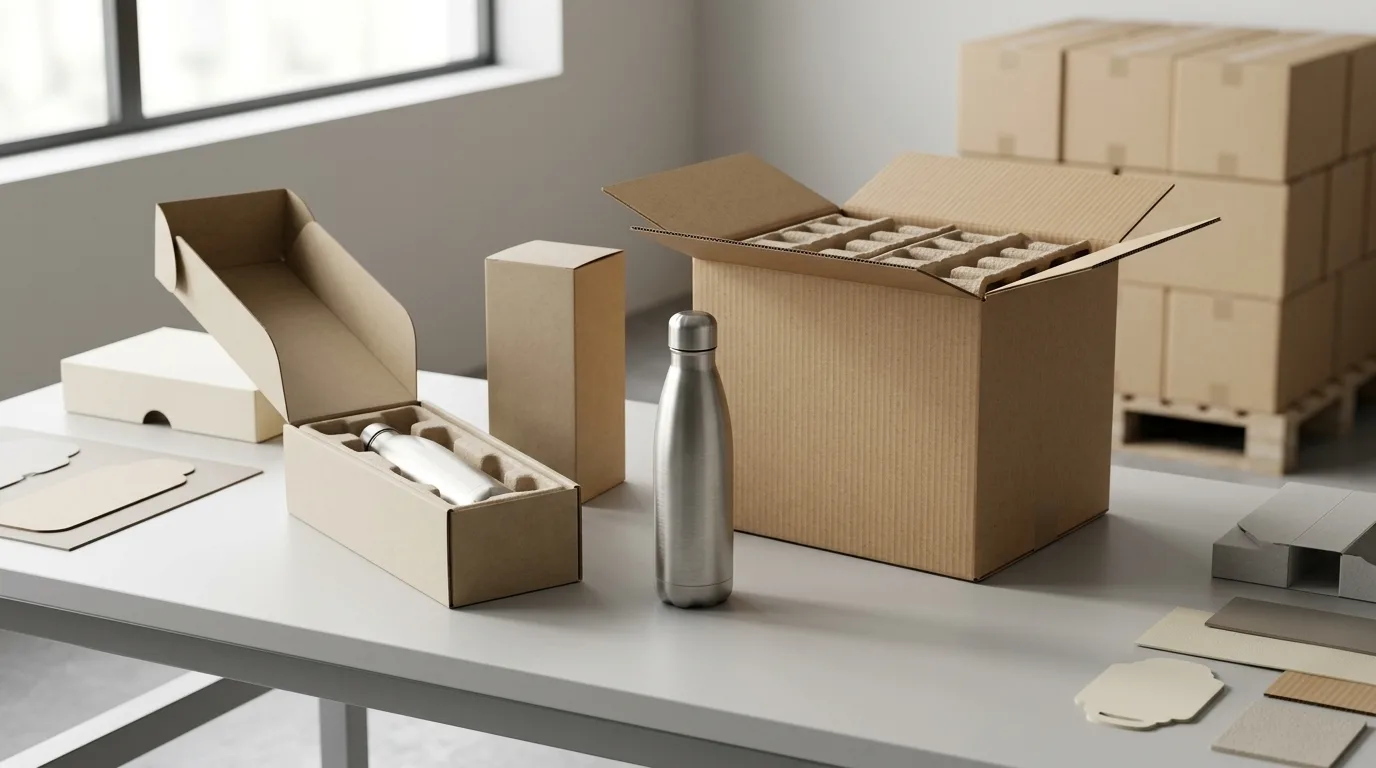
What to Consider When Developing Insulated Drinkware Packaging
l Start with the Product
The packaging structure should be developed around the finished product, including its dimensions, surface finish and areas that need additional protection.
This is particularly important for products with delicate surface treatments or components that may move inside the box. The inner insert needs to hold the product firmly in place and reduce contact between the product and the packaging during transportation.
l Define the Sales Channel Early
The same drinkware product may require different packaging depending on its sales channel. Before deciding on the box structure and materials, it helps to establish whether the product is intended for e-commerce, retail, gifting, wholesale or a large international order. This affects the balance between protection, presentation, cost and packing efficiency.
l Check Packaging Dimensions Against Logistics
Packaging size has a direct effect on shipping efficiency. Even a small change to the length, width or height of a retail box can change the number of units that fit into a master carton. That, in turn, may affect container loading and the logistics cost per unit.
For large-volume orders, packaging dimensions should therefore be reviewed together with carton size, packing quantity and container loading plans rather than treated as a separate packaging decision.
l Confirm Compliance Requirements Before Production
Packaging requirements vary across markets and customers. Depending on the destination and sales channel, this may include environmental requirements, product information, barcodes, warning statements and shipping marks. Confirming these details before artwork and production are finalized helps reduce the risk of reprinting or changing the packaging later.
Packaging Requirements by Sales Channel
1. E-Commerce
E-commerce packaging has to handle repeated parcel handling, sorting and delivery. At the same time, oversized packaging can increase dimensional-weight charges. For standard drinkware products, a practical solution is often a retail box with a separate protective shipping carton. Where the retail box itself is strong enough, an additional outer package may not be necessary.
Packaging dimensions should be kept as compact as practical, especially for products shipped directly to consumers. For standard SKUs, simple tuck-end or crash-lock boxes are often sufficient. More elaborate gift boxes can be reserved for gift-oriented products where the additional packaging cost is justified.
Barcodes should be clearly printed and easy to scan. Window boxes need additional attention because the cut-out can reduce overall box strength. A stronger insert or an outer shipping carton may be needed to protect the product.
2. Supermarkets and Retail Stores
For retail stores, packaging needs to work both on the shelf and during customer handling. A window box can be useful when product visibility is important, allowing shoppers to see the shape, finish and overall appearance of the drinkware without opening the package.
At the same time, the box should have enough rigidity to remain upright and presentable during display and stacking. Barcode placement should also be consistent with the retailer's requirements. One issue with window packaging is that the opening can reduce structural strength. The inner insert should therefore provide adequate support and help prevent scratches when customers pick up or handle the product.
For seasonal displays or holiday promotions, gift-style packaging can be used where presentation is part of the product offering.
3. Gift and Corporate Purchasing
Packaging has a different role in gift programs, corporate purchasing and employee gift projects. Presentation and the unboxing experience often carry more weight than maximum packing efficiency. Common options include rigid two-piece gift boxes, drawer-style or sleeve boxes, specialty papers, foil stamping and molded inserts such as EVA. The packaging can also incorporate corporate logos and other brand elements, with matching paper bags added where needed. Compared with mass-market or wholesale packaging, these projects generally allow more room for packaging cost, especially when the packaging itself is part of the perceived value of the gift.
4. Wholesale and Distribution
Wholesale distribution usually places greater emphasis on cost, durability and efficient packing. For hardware stores, household-goods distributors and similar channels, packaging can often be simplified by reducing decorative printing and unnecessary finishing processes. The outer carton should be strong enough for stacking and long-distance transportation, while the packing configuration should make good use of available carton space. In this type of channel, practical packaging that keeps handling and logistics costs under control is usually more important than premium gift-style presentation.
5. International OEM/ODM Orders
For international OEM/ODM projects, packaging specifications are often provided by the customer and need to be followed closely. Requirements may cover the box structure, barcode position, shipping marks, warning information, inner inserts, packaging materials, carton dimensions and packing quantity. For large orders, packaging dimensions also need to be checked against container loading plans. A well-designed carton should provide adequate protection while making efficient use of shipping space. Carton compression strength is another important consideration, particularly when multiple cartons are stacked during storage and transportation.
Developing Packaging and Logistics Together
For insulated drinkware, packaging decisions do not stop at the retail box. Product dimensions, surface finish, inner protection, carton configuration and container loading all affect one another.
A typical development sequence may look like this:
Product dimensions and structure → Surface finish → Inner protection → Retail packaging → Master carton → Container loading
The target sales channel should be considered throughout the process. For large OEM/ODM projects, early coordination between the brand and the manufacturer can also help align product dimensions, packaging structure, packing quantities and production requirements before mass production begins.