


When evaluating the food contact safety of a stainless steel insulated bottle or tumbler, the first specification many people look at is the stainless steel grade. 304 and 316 are widely used in drinkware, but the stainless steel grade is only one part of the equation.
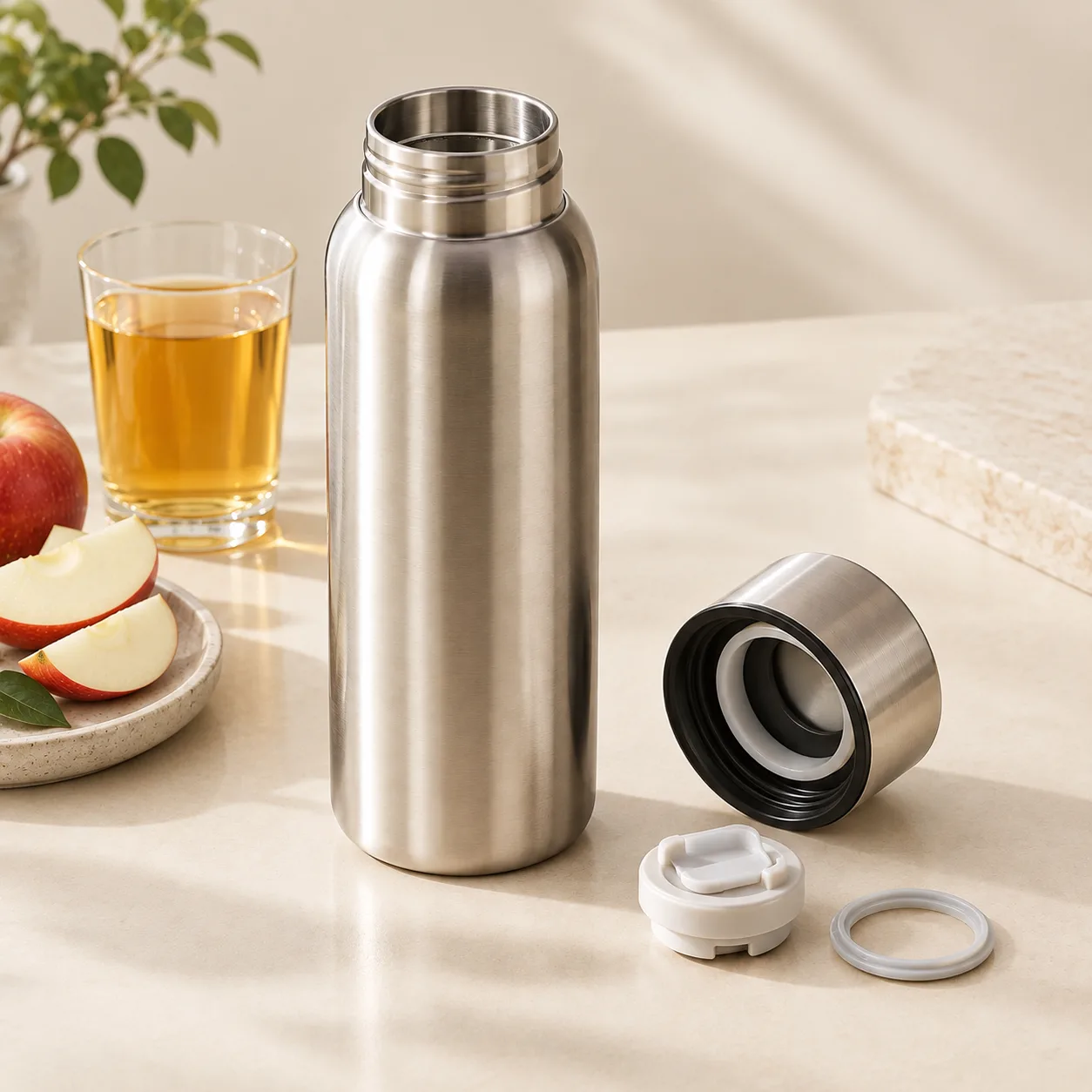
A finished insulated bottle may also contain plastic lid components, silicone gaskets, internal coatings and other materials that come into contact with beverages. Welding, surface treatment, cleaning and production controls also affect the condition of these components. For this reason, food contact safety should be evaluated at the **finished-product level**, not based on a single material marking.
1. Why Are 304 and 316 Stainless Steel Widely Used?
The food-contact performance of stainless steel is closely related to its passive surface layer.
Chromium in stainless steel reacts with oxygen to form a thin chromium-rich oxide layer on the surface. This passive layer helps protect the underlying metal from corrosion and limits direct interaction between the metal and the beverage.
l SUS304 Stainless Steel
SUS304 is widely used because it combines corrosion resistance, durability and good formability for many everyday applications. It is commonly used for bottles and tumblers intended for water, tea, coffee and other beverages.
l SUS316 Stainless Steel
SUS316 contains molybdenum in addition to its other alloying elements. This improves its resistance to certain corrosive environments, particularly those involving chloride ions.
It may therefore be selected when a product requires higher corrosion resistance or is expected to face more demanding contact conditions.
l A Steel Grade Alone Is Not Enough
A marking such as "304" or "316" does not by itself demonstrate that a finished product is food-contact compliant.
The actual result also depends on raw material quality, manufacturing processes, surface condition and applicable testing requirements.
Welding, polishing and other processing steps can affect the final surface, while other components of the bottle may have their own food-contact requirements.
The finished product needs to be evaluated as a complete system.
Food Contact Safety Goes Beyond the Stainless Steel Liner
An insulated bottle is made from multiple materials, and any component that directly contacts the beverage needs to be selected and controlled appropriately.
l Plastic Components
Lids, stoppers and drinking components may be repeatedly exposed to hot water or beverages. Food-contact plastics need to meet the requirements applicable to their intended use, including controls related to material composition and migration.
Poor material selection or unsuitable processing can result in unwanted odors or migration under certain conditions.
l Silicone Sealing Rings
Silicone sealing rings play an important role in both sealing and product performance. Because gaskets can repeatedly come into contact with hot and cold beverages, the silicone formulation and manufacturing quality need to be properly controlled.
Depending on the applicable requirements, testing may cover migration, volatile substances and other material-specific indicators. The gasket also needs to retain its sealing properties during repeated temperature changes and normal use.
l Internal Coatings
Some insulated drinkware uses ceramic, non-stick or other internal coatings for specific functional purposes. The key consideration is not simply whether a coating is used, but whether the coating material, curing process and adhesion are properly controlled.
A suitable internal coating needs to meet the applicable food-contact requirements and remain stable under intended conditions of use. Poor curing, inadequate adhesion or repeated mechanical and thermal stress can affect coating integrity.
l Stainless Steel Surface Treatment
Surface treatment is another part of the food-contact system that is easy to overlook. During welding, the local stainless steel surface can be affected by heat. Appropriate post-weld treatment helps restore the required surface condition and corrosion resistance.
Polishing and electrochemical polishing can also improve surface smoothness. A cleaner, more uniform inner surface is easier to maintain and less likely to provide areas where residues can accumulate. For manufacturers, controlling the condition of the inner liner is therefore part of the overall food-contact safety process.
What Do FDA, LFGB and GB 4806 Requirements Cover?
Different markets apply different requirements to food-contact materials. The exact requirements depend on the material, product construction, intended use and destination market. For international drinkware projects, brands may encounter requirements associated with U.S. FDA provisions, the German LFGB framework and the GB 4806 series in China.
Depending on the product and material, compliance testing may cover areas such as:
-Overall or specific migration
-Heavy metals
-Material-specific chemical requirements
-Sensory characteristics
-Plastic and silicone requirements
-Coating-related requirements
l Different Materials Require Different Evaluation
A stainless steel liner, plastic lid and silicone gasket may be subject to different requirements and test methods. These components should therefore be evaluated according to their intended use and the regulations applicable to the target market.
l A Raw Material Report Does Not Represent the Complete Product
A report covering only the stainless steel raw material does not automatically demonstrate food-contact compliance for the complete bottle. The relevant food-contact components need to be evaluated as part of the finished product.
For products sold in multiple markets, applicable requirements should be confirmed before materials and production specifications are finalized.
How Do Manufacturers Control Food Contact Safety?
Food contact safety needs to be managed from incoming materials through finished-product verification.
l Raw Material Control
Stainless steel sheet, plastic resin, silicone and coating materials should come from qualified suppliers and be supported by appropriate material and compliance documentation.
Incoming inspection provides another level of control by checking material specifications before production begins.
l Process Control
Manufacturing processes can affect both material performance and surface condition.
Depending on the product, key controls may include:
-Welding parameters and weld quality
-Post-weld surface treatment or passivation
-Polishing and electrochemical polishing
-Coating application and curing
-Plastic molding conditions
-Silicone component quality
-Production environment and cleanliness
These controls help prevent defects from being carried into the finished product.
l Laboratory Verification
Testing provides the final verification that materials and processes meet the applicable requirements. Depending on the product and target market, testing may include migration, heavy metals, sensory evaluation and other material-specific checks.
Internal laboratory testing can support routine quality control, while qualified third-party laboratories can be used for formal compliance verification. For international drinkware projects, testing also provides a way to verify that material selection and production controls are achieving the intended result.
What Should Brands Check When Selecting a Drinkware Manufacturer?
For OEM and ODM drinkware projects, checking the stainless steel grade is only a starting point.
l Material Control
The manufacturer should have clear specifications and traceable control for stainless steel, plastics, silicone and coatings.
l Process Control
The manufacturer should have defined procedures for welding, surface treatment, coating and component production.
l Testing Capability
The manufacturer should have access to appropriate laboratory testing for routine quality verification and target-market compliance.
l Compliance Documentation
Material records, test reports and other relevant compliance documentation should be available for the applicable food-contact components.
l Multi-Market Support
For products sold across multiple markets, the manufacturer should be able to identify different food-contact requirements and coordinate the relevant testing and documentation.
Food Contact Safety Is a Complete Product System
A stainless steel insulated bottle cannot be considered food-contact compliant simply because the liner is marked 304 or 316.
The stainless steel grade provides the material foundation, while plastic and silicone components, internal coatings, surface treatment, manufacturing controls and compliance testing all contribute to the final result.
For brands developing insulated drinkware, food contact safety should therefore be considered from the beginning of product development.
Selecting appropriate materials, controlling the manufacturing process and validating the finished product together provide a stronger basis for meeting food-contact requirements across different markets.
Food Contact Safety Starts With the Complete Product
304 or 316 stainless steel is only one part of food-contact safety. Plastic and silicone components, coatings, surface treatment, manufacturing controls and compliance testing all contribute to the final result.
For product development, this means food-contact requirements should be considered early, helping avoid material changes or compliance issues later in the project.