


Overview
A vacuum structure reduces heat transfer, but vacuum insulation alone does not eliminate all forms of heat transfer. Heat moves through three main paths: heat conduction, heat convection, and thermal radiation.
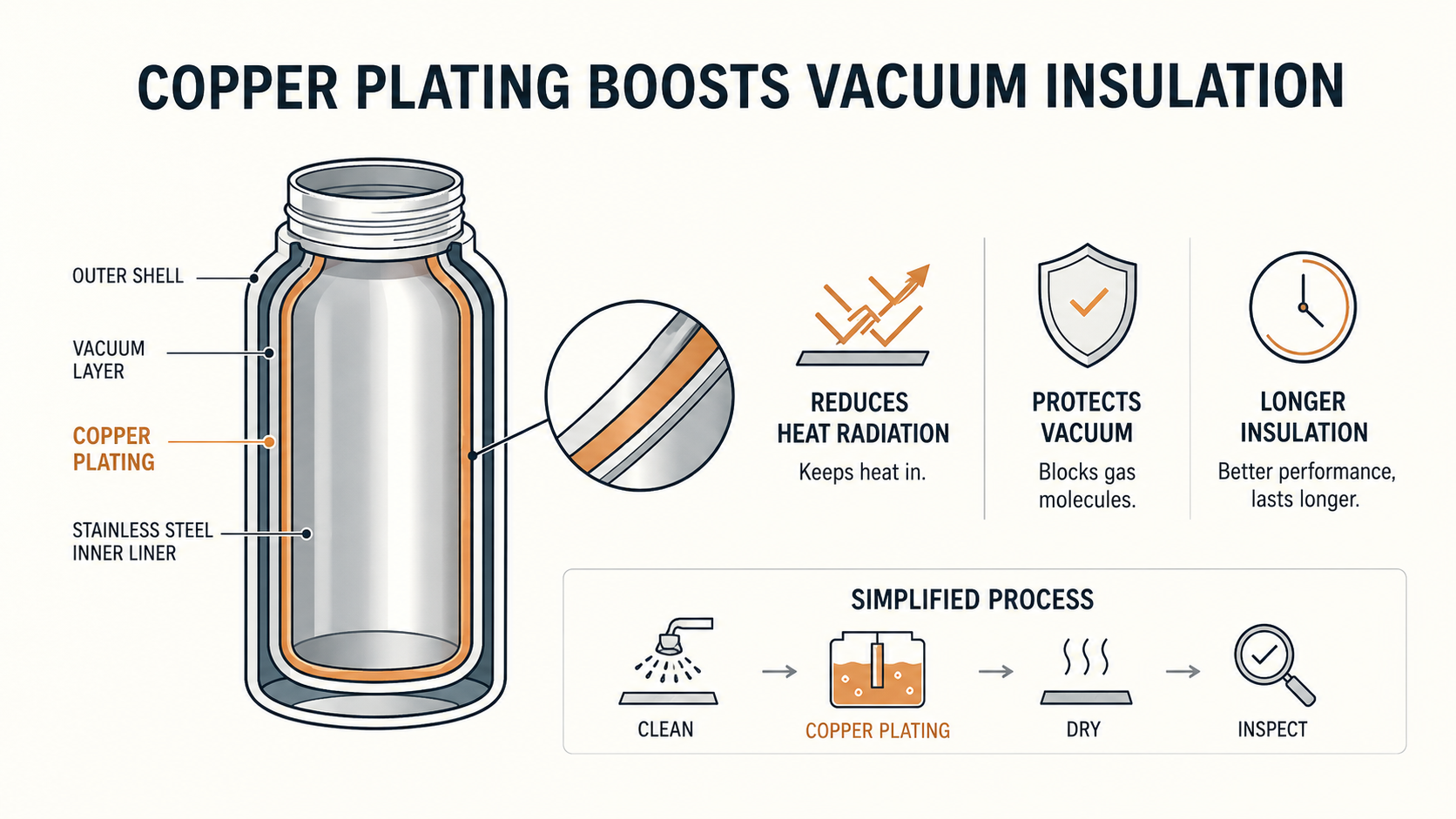
Vacuum mainly helps reduce conduction and convection, while thermal radiation still needs to be addressed. This is where copper plating on the outer surface of the inner liner comes into play.
By adding a reflective copper layer to the inner liner, manufacturers can further optimize the thermal insulation structure of a stainless steel vacuum bottle.

What Does Copper Plating Do?
A copper layer is applied to the outer surface of the stainless steel inner liner. Copper has high reflective properties and low infrared emissivity. The plated copper layer forms a reflective surface that can reflect infrared heat energy radiated from inside the bottle back toward the interior. This helps reduce radiant heat loss and improve insulation performance.
The location of the copper layer is important. It is applied to the outer surface of the inner liner, where it sits within the vacuum structure. It therefore works together with the vacuum layer rather than replacing it.
In a typical vacuum-insulated structure, the two technologies address different parts of the heat-transfer process:
Vacuum Layer → Reduces Heat Conduction & Convection
Copper Reflective Layer → Helps Reduce Thermal Radiation
Together, they provide a more comprehensive approach to thermal insulation.
What Other Functions Does Copper Plating Provide?
(1) Helps Reduce Gas Release from the Stainless Steel Substrate
The copper layer forms a dense barrier over the stainless steel substrate. According to the provided process information, this can help reduce the release of metal ions and gases into the vacuum cavity. Reducing gas release can help slow vacuum degradation and support the service life of the insulated bottle.
This means the copper layer is not only related to thermal performance. It also plays a role in maintaining the condition of the vacuum structure over time.
(2) Helps Reduce Deformation During Vacuum Processing
Copper has high thermal conductivity. During the high-temperature vacuum process, the copper layer can help reduce local temperature differences and the resulting thermal stress.
This can help reduce deformation-related defects during vacuum processing and contribute to more stable manufacturing results
What Are the Alternatives to Copper Plating?
Copper plating is not the only approach available for improving the thermal structure. The provided manufacturing information identifies two alternatives or enhanced approaches:
• Silver plating
• Copper plating + copper film
Different approaches can therefore be considered according to the required product performance and construction. For OEM and ODM drinkware development, the appropriate approach depends on the intended insulation performance and the overall product structure.
What Are the Requirements for Copper Plating?
(1) Substrate Preparation
The outer surface of the inner liner needs to be cleaned thoroughly to remove:
• Oil
• Oxide scale
Proper surface preparation helps ensure good adhesion of the copper layer.
(2) Copper Coating Thickness
The reference copper coating requirements are:
• Copper thickness: ≥ 0.6 μm
• Blank area around the bottle opening: approximately 10–20 mm
• Full copper coverage on other areas
The required surface appearance is:
• Rose-red mirror finish
• No missed plating
• No pits
• No black oxidation marks
• No peeling or flaking
What Does the Copper Plating Process Look Like?
The copper plating process can be understood as:
Surface Cleaning → Copper Plating → Coating Formation → Quality Inspection
The prepared inner liner is mounted for electroplating and immersed in a copper sulfate solution. Under the applied electrical current, copper ions are deposited onto the outer surface of the liner to form the coating. After plating, the component is checked for coating thickness, coverage, and surface condition. Consistent preparation and coating control are important because variations in the copper layer can affect both appearance and the intended functional performance.
Copper Plating and Vacuum Insulation
Copper plating should be understood as part of the overall thermal insulation structure rather than as an independent process. The relationship can be simplified as:
Vacuum Layer → Reduces Conduction & Convection
Copper Reflective Layer → Helps Reduce Thermal Radiation
Together, these technologies contribute to the overall insulation performance of the vacuum bottle.
Why Does Copper Plating Matter for Drinkware Manufacturing?
For insulated drinkware, copper plating connects material treatment with thermal performance.
The quality of the copper layer depends on:
Surface Preparation + Coating Thickness + Coverage + Surface Condition
For drinkware development, controlling these factors helps ensure that the intended copper-plated structure can be consistently reproduced during production.
Copper Plating in OEM and ODM Drinkware Development
For OEM and ODM projects, copper plating is one of the manufacturing factors that can be evaluated during product development. A product may require a specific thermal performance target while also requiring stable mass production, consistent bottle dimensions, and reliable vacuum performance. In such cases, copper plating cannot be considered separately from the rest of the bottle structure.
At Ansune, copper plating can be integrated into the broader stainless steel vacuum bottle manufacturing process. Surface preparation, plating coverage, coating thickness, and surface condition can be controlled according to the product requirements.