


Market Overview
The stainless steel vacuum bottle market is evolving beyond traditional thermal insulation. Brands are competing across a wider range of use cases, from everyday hydration and commuting to fitness, travel, and outdoor recreation. As a result, product differentiation increasingly depends on how well a bottle fits its intended use, how easily it integrates into daily routines, and how clearly it communicates a brand’s identity.
According to DIResearch’s market report, the global stainless steel vacuum bottle market is forecast to grow from approximately USD 7.41 billion in 2025 to USD 14.39 billion by 2032, representing a projected CAGR of 9.94%.
For drinkware brands, the commercial opportunity lies in identifying the right product segments rather than treating the market as a single category. Capacity, drinking method, portability, surface finish, and price point all influence the type of product that will appeal to a particular consumer group. These factors also determine how a product should be developed and manufactured.
What Is Driving Demand?
- Everyday Hydration and Material Confidence
Reusable bottles have become part of daily routines at work, during commutes, at school, and while travelling. For these applications, consumers need products that can withstand repeated use, maintain beverage temperature, and remain convenient to carry, open, and clean. Material safety is another important consideration, particularly for products intended for repeated food and beverage contact. Brands need to assess the complete product structure, including the stainless steel body, lid, seals, and other components that contact the beverage. Material selection and applicable food-contact compliance should be established early in development rather than treated as final-stage checks.
- Sustainability and Product Longevity
Reusable drinkware aligns with consumer interest in reducing reliance on disposable products. PwC’s 2024 Voice of the Consumer Survey found that 80% of surveyed consumers were willing to pay more for sustainably produced or sourced goods, with an average stated willingness to pay a premium of 9.7%. These figures indicate consumer interest, although stated willingness to pay does not necessarily translate into actual purchases. For drinkware brands, sustainability claims need credible product-level support. Durable construction, long-term usability, responsible material choices, and appropriate packaging are more useful considerations than relying on reusability alone to establish a sustainability position.
- Outdoor, Fitness and Travel
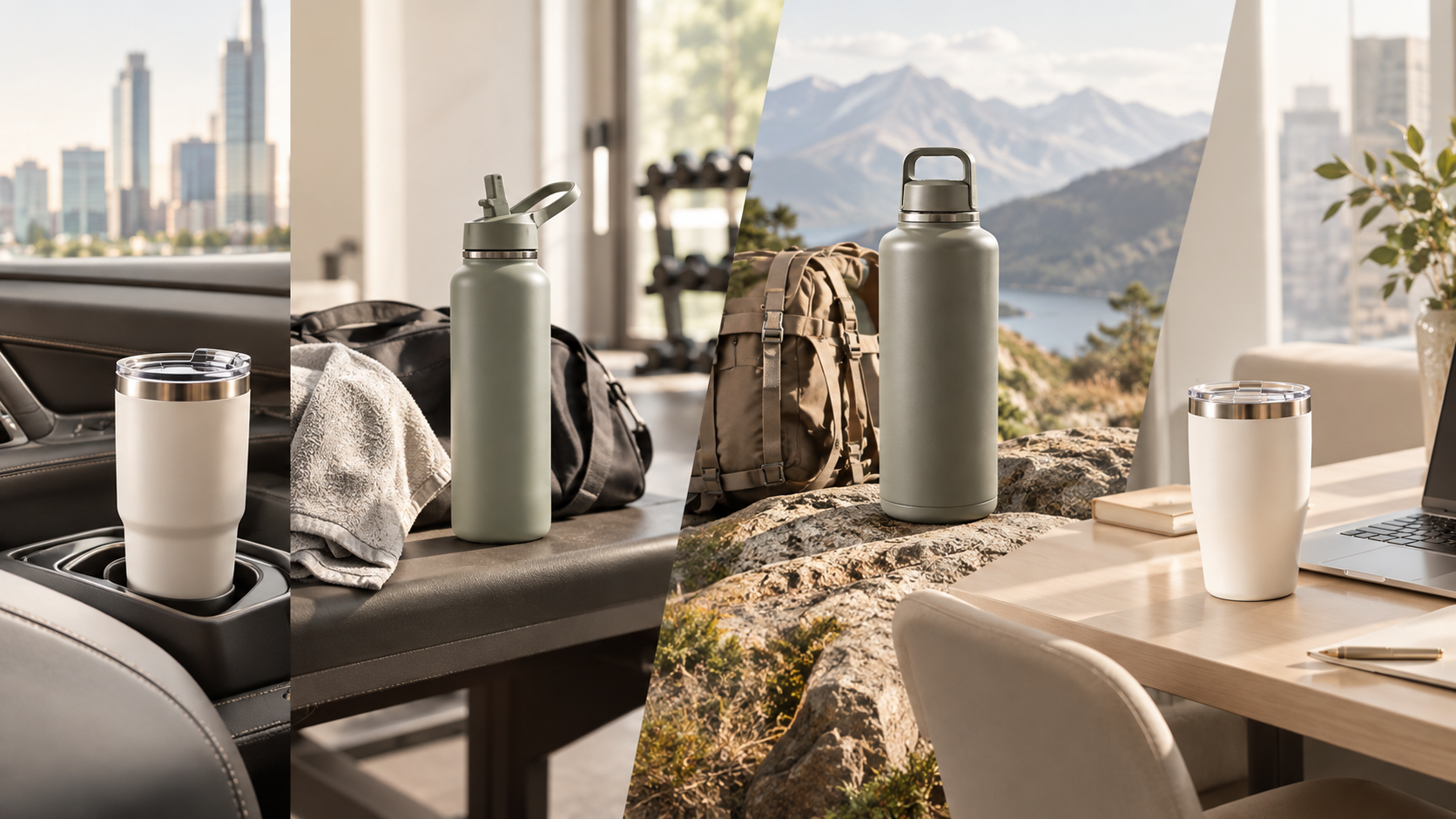
Outdoor recreation and active lifestyles create demand for bottles suited to different conditions and activity levels. The Outdoor Industry Association’s 2026 participation report counts 183.2 million Americans participating in outdoor recreation, illustrating the scale of this broader use environment. Product requirements vary considerably across these applications. A bottle designed for commuting may prioritize a compact footprint, one-handed operation, and compatibility with car cup holders. Hiking and camping products may place greater emphasis on capacity, carrying options, and resistance to demanding use conditions. Fitness products often need a convenient drinking mechanism and a shape that is easy to grip during movement. The implication for product planning is clear: a bottle that performs well in one setting may not be the most suitable choice for another. Usage scenarios should therefore guide product specifications from the outset.
- Lifestyle-Oriented Design
In a crowded category, basic insulation performance may be insufficient to establish a distinctive market position. Color, silhouette, surface texture, finish, and lid design can help a product stand apart, particularly when competing products offer similar core functionality. Design decisions also influence how products work as a coordinated collection. A consistent visual language across multiple capacities and formats can strengthen brand recognition, while differentiated finishes and details can create distinct product tiers. For brands, the challenge is to develop a recognizable appearance that remains practical to manufacture consistently at scale.
Product Development Trends
1. Capacity and Product Portfolio Planning
Capacity should be selected according to the intended use. A larger bottle reduces the need for refills but increases filled weight and may become less convenient to carry. Smaller formats can be easier to handle and store, but may not meet the needs of users who spend long periods away from a refill point. For brands, developing several capacities within one product family can address different use cases while maintaining a coherent design identity. The key is to establish the target capacity range, overall dimensions, and handling requirements before finalizing tooling and component specifications.
2. Lid Systems and Functional Innovation
The lid is one of the most important determinants of everyday usability. Straw lids, direct-drinking openings, one-handed mechanisms, locking features, and integrated handles each address different needs, but they also introduce different structural and manufacturing considerations. A more complex lid may improve convenience, yet it can increase the number of components, assembly requirements, and potential points of failure. Sealing performance, cleaning access, component fit, and ease of operation therefore need to be evaluated together.
For product teams, the objective is to identify which functions genuinely serve the target user. A well-executed lid system can create a meaningful point of differentiation without requiring a completely new bottle body.
3. CMF and Surface Finishing
Color, material, and finish (CMF) have become important tools for building a distinctive drinkware collection. Solid colors, gradients, textured surfaces, metallic effects, and other finishing options provide different ways to express brand identity and differentiate product lines. However, the development process needs to account for mass-production requirements. Color samples may look different under different lighting conditions, while surface treatments can vary in appearance and durability depending on the material and process. Brands should establish clear finish specifications and evaluate appearance consistency, abrasion resistance, and cleaning requirements where applicable.
For OEM and ODM development, a coordinated CMF approach can help maintain visual consistency across different product sizes and formats. Early sampling and clear approval standards are essential to reducing discrepancies between approved samples and mass-produced units.
4. Ergonomics and Usage Scenarios
A bottle’s usability depends on more than its external appearance. Body diameter, grip position, handle clearance, lid operation, and weight distribution all affect how comfortable it is to carry and use. These factors become particularly important for larger capacities or designs intended for frequent movement. Packaging dimensions, storage, and transportation should be considered as well. A design that looks appealing in a product image may present practical limitations if it is difficult to hold, clean, store, or pack efficiently.
Evaluating the complete user experience during product development helps brands identify these issues before the design reaches mass production.
What These Trends Mean for Brands and Procurement Teams
Brands should define key product requirements early, including capacity, lid design, materials, surface finish, target price, and compliance needs. These specifications should guide sampling and testing for thermal performance, leak resistance, durability, and finish consistency. When evaluating OEM and ODM partners, brands should look beyond sample quality and production capacity. The ability to translate design requirements into consistent, scalable products is essential to maintaining product performance and appearance in mass production.
Key Takeaways
The stainless steel vacuum bottle market is seeing greater emphasis on usage-specific capacities, versatile lid systems, distinctive surface finishes, and improved ergonomics. These trends reflect growing demand for products tailored to different lifestyles, functional needs, and aesthetic preferences.
As product expectations evolve, brands are placing greater importance on balancing thermal performance, everyday usability, visual differentiation, and manufacturing feasibility. The ability to translate these trends into practical product designs will play an important role in shaping future drinkware development.