


Market Overview
The global stainless steel vacuum bottle market is expanding as consumers place greater emphasis on healthy hydration, reusable products, outdoor activities, and lifestyle-oriented drinkware.
According to DIResearch, the global stainless steel vacuum bottle market is expected to reach approximately USD 7.4 billion in 2025 and USD 14.4 billion by 2032, representing a CAGR of about 9.9% from 2025 to 2032. Search interest in terms such as “insulated bottle” and “stainless steel bottle” has also remained strong, with demand typically rising during summer and around major holiday shopping periods.
What Is Driving Demand?
l Healthy Hydration
Consumers are paying more attention to drinking water safety and the materials used in everyday drinkware. Stainless steel bottles offer durability, reusability, and temperature retention, making them a common alternative to disposable plastic containers. Material safety is also an important consideration for brands developing products for food and beverage contact.
l Sustainability
The shift toward reusable products continues to support stainless steel drinkware. PwC's 2024 Global Consumer Insights Survey found that around 80% of consumers were willing to pay more for sustainably produced or sourced goods, with an average willingness to pay a premium of approximately 9.7%. Durable and reusable stainless steel products fit this preference for reducing reliance on single-use products.
l Outdoor, Fitness and Travel
Outdoor recreation, fitness, travel, and camping are creating demand for drinkware that is portable, durable, leak-resistant, and capable of maintaining beverage temperature. According to the Outdoor Industry Association, 175.8 million Americans participated in outdoor recreation in 2023, representing 57.3% of the U.S. population aged six and older. These usage patterns are supporting demand for larger bottles, insulated sports bottles, and products designed for multiple situations.
l Lifestyle-Oriented Design
Product choice is increasingly influenced by more than insulation performance. Color, shape, surface finish, lid design, and overall usability are becoming important parts of product differentiation. Brands such as Stanley, YETI, and Owala have demonstrated how drinkware can combine functionality, design, and social media exposure to build stronger lifestyle positioning.
Product Development Trends
l More Capacity Options
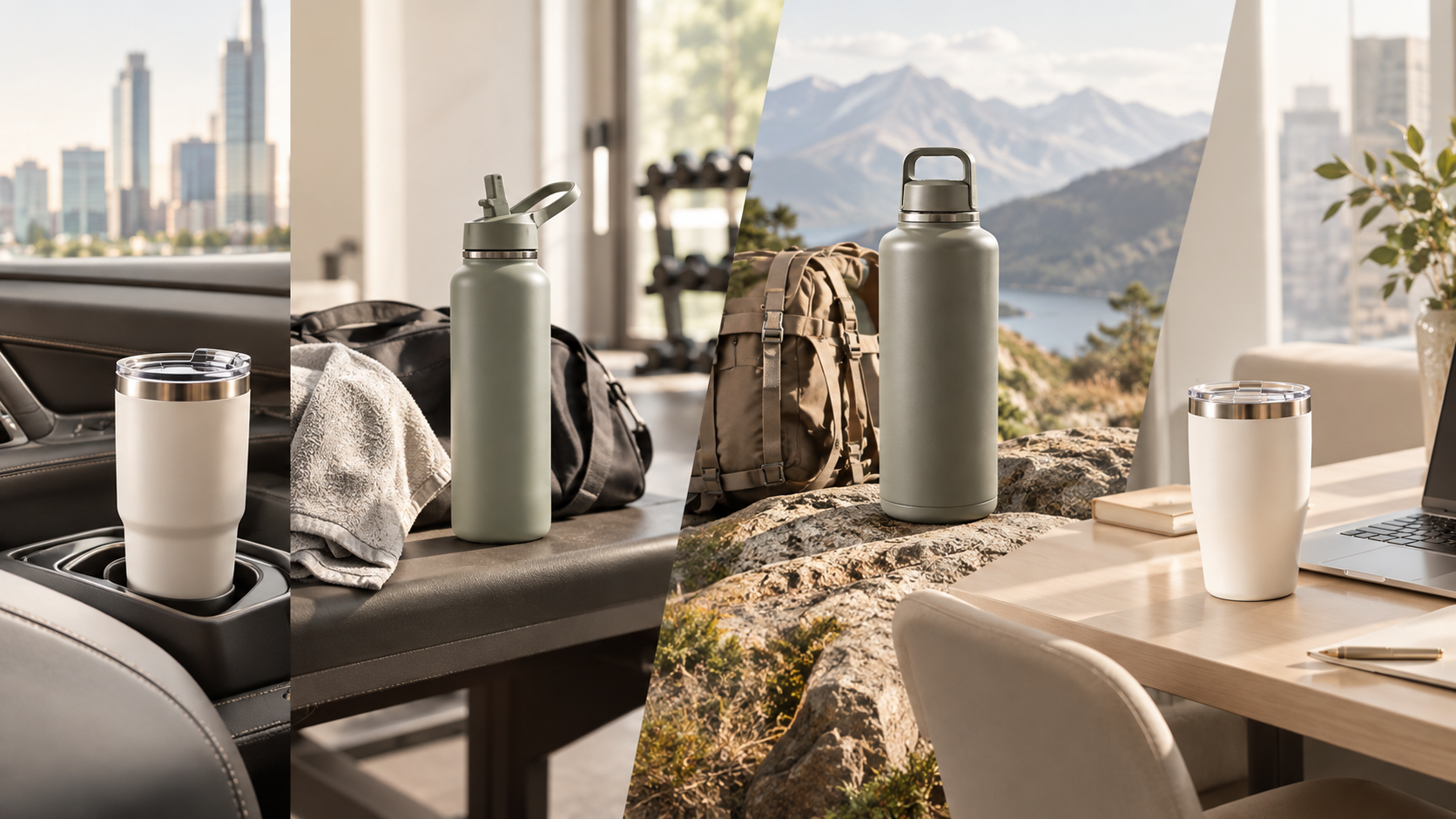
Capacity is becoming more closely linked to usage. Smaller and medium-sized bottles remain common for commuting, office use, and everyday hydration, while 32 oz and larger formats are gaining attention for outdoor activities, fitness, and longer periods between refills. This creates opportunities for brands to develop multiple capacities within the same product family.
l CMF and Surface Finishing
Appearance has become an important tool for brand differentiation. Solid colors remain widely used, while gradients, textures, special coatings, and other finishing techniques give brands more ways to create distinctive product lines.
For OEM and ODM projects, CMF (Color, Material and Finish) can be used to maintain a consistent visual identity across different sizes and product categories.
l Functional and Lid Innovation
Product development is moving beyond basic insulation toward everyday usability. Current directions include easier lid opening, leak-resistant structures, straw and direct-drinking options, ergonomic handles, car cup holder compatibility, improved portability, and replaceable accessories. Lid configurations can also be adapted to different use cases without changing the basic bottle concept.
l Ergonomics and Usage Scenarios
As capacity increases, handling becomes more important. Handle structure, grip position, bottle shape, and weight distribution all affect portability and daily use.
Product requirements also vary by scenario. Commuter products tend to prioritize portability, cup holder compatibility, and convenient operation. Outdoor products place more emphasis on capacity, durability, and insulation. Fitness products focus on easy drinking and carrying, while office and coffee products tend to place greater emphasis on appearance and drinking comfort.
What These Trends Mean for Brands and Procurement Teams
For brands and procurement teams, market trends are increasingly connected to product planning. Capacity, lid structure, CMF, accessories, and intended usage scenario all need to be considered before mass production.
Rather than using one standard product for every market, brands can develop product families around specific consumer needs and usage situations. OEM and ODM manufacturing also provides flexibility to adapt structures, finishes, materials, and product configurations to different target markets.
For manufacturers, this means product development capability is becoming as important as production capacity. Material knowledge, structural development, surface finishing, customization, and quality control can all influence supplier selection.
Key Takeaways
The stainless steel vacuum bottle market is being shaped by several overlapping trends: healthy hydration, sustainability, outdoor lifestyles, lifestyle-oriented design, and demand for more specialized products.
For brands and procurement teams, product planning increasingly needs to consider capacity, functionality, design, and usage scenario together. For OEM and ODM projects, the ability to turn these market requirements into consistent, scalable products is becoming an important part of supplier selection.