


For brands looking for an insulated drinkware manufacturing partner, the first question is usually straightforward: Can this factory make my product?
Production capability matters, but it is only the starting point. For long-term OEM and ODM cooperation, brands also need to evaluate quality systems, testing capabilities, development support, production stability, communication, and supply chain flexibility.
A supplier may be able to produce a sample successfully. The more important question is whether it can continue to deliver the same product quality and performance when volumes increase, specifications change, or new products are added.
1. Compliance and Quality Management
A reliable manufacturer should have a defined quality management system and be able to provide the compliance documentation required for the target market.
Depending on the product and destination, this may include FDA requirements, LFGB, EU food-contact regulations, and relevant material or product testing reports.
It is also worth looking at how compliance is managed, rather than simply checking whether certificates are available. A supplier that maintains testing and quality records as part of its regular production process is generally better positioned to respond when new products or market requirements arise.
Ansune, for example, states that its quality system is supported by an in-house CNAS-certified laboratory, with testing covering areas such as temperature retention, durability, and food safety. Its website also lists compliance with FDA, LFGB, ISO, and other international standards.
2. In-House Testing Capabilities
Internal testing can shorten the feedback loop between production and quality control.
When evaluating a supplier, brands can look at whether the manufacturer has its own testing equipment, dedicated quality personnel, and standardized procedures for areas such as materials, sealing, insulation, durability, and appearance.
The value is not simply having a laboratory. What matters is whether testing is integrated into product development and production, so potential issues can be identified before they become large-scale production problems.
For a manufacturer such as Ansune, an in-house laboratory forms part of the broader quality-control process rather than functioning only as a final inspection point.
3. Production Capacity and Delivery Stability
Factory size alone does not tell a brand whether a supplier can handle growth. A more useful evaluation looks at the manufacturer's actual production setup, available lines, automation level, peak-season performance, repeat-order consistency, and ability to maintain quality as volumes increase.
This becomes particularly important when a product moves from sampling to a large retail program. The supplier needs to be able to scale production without making significant changes to materials, processes, or quality standards.
Ansune currently operates manufacturing bases in China and Malaysia, with more than 60% of production processes automated and a maximum planned annual capacity of 105 million units across its manufacturing network.
4. Product Development and Sampling
For a design-driven category such as insulated drinkware, manufacturing and product development are closely connected.
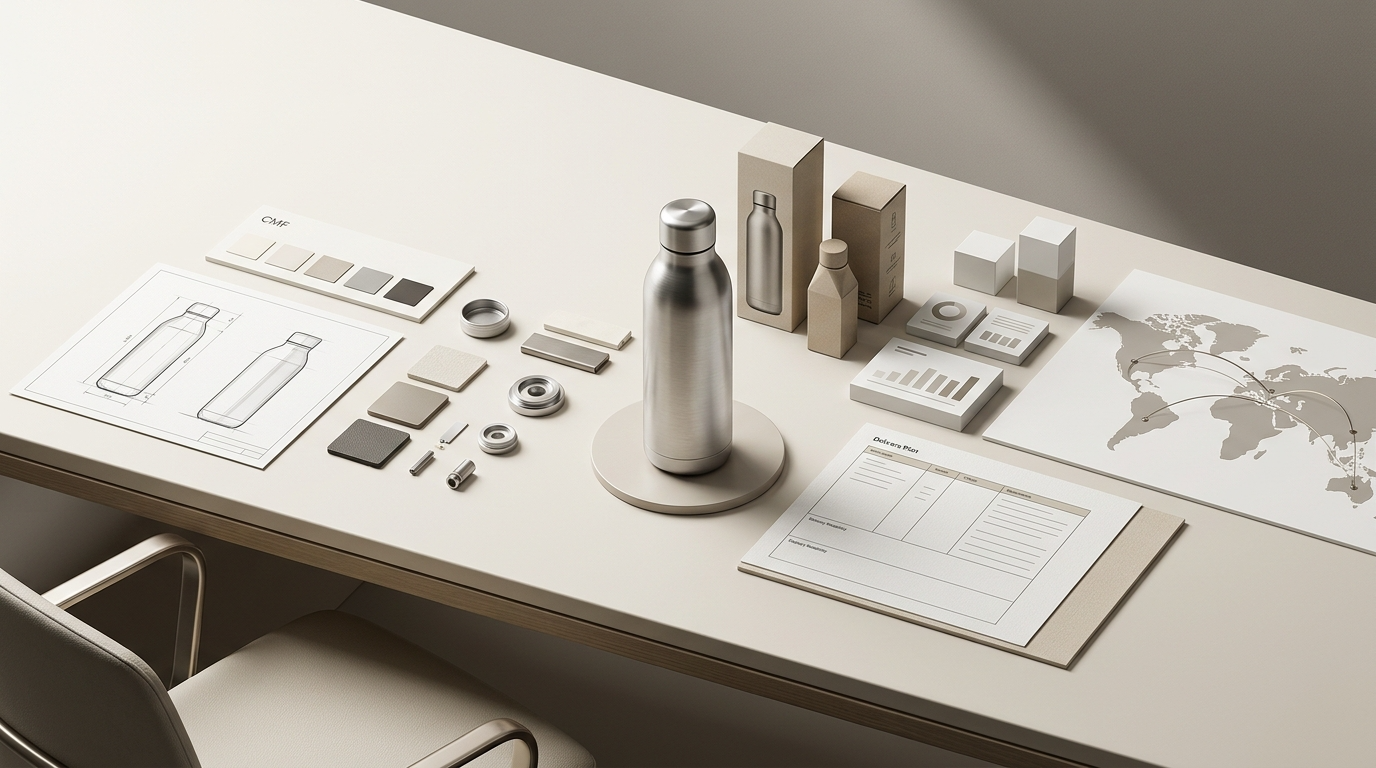
Brands should evaluate whether a supplier can support structural development, sampling, CMF, color matching, surface finishing, component development, and repeated sample revisions. The ability to move from an initial concept to a manufacturable sample can have a direct impact on development timelines.
Ansune has more than 200 in-house ODM designers, invests more than 10% of annual revenue in R&D, and maintains CMF capabilities in both China and Malaysia. Its manufacturing network also includes processes ranging from forming and metalworking to vacuumization, surface treatment, plastic injection molding, assembly, and packaging.
For brands, the relevant question is not simply how quickly a supplier can make a sample, but whether it can help turn a design concept into a product that can be manufactured consistently at scale.
5. Communication and Project Management
OEM manufacturing involves continuous communication between product, engineering, quality, purchasing, and production teams. During the development stage, brands can assess how quickly a supplier responds to technical questions, design changes, sample feedback, and production issues.
Clear communication becomes particularly important when a project involves multiple components or repeated revisions. A supplier should be able to keep technical requirements, sample changes, timelines, and quality issues aligned across different teams.
A practical way to assess this is to treat the sampling stage as part of the supplier evaluation process rather than judging the manufacturer only by the final quotation.
6. Production Locations and Supply Chain Flexibility
For brands serving multiple markets, production location can become an important part of supplier selection.
Different markets may require different product configurations, packaging, order volumes, or delivery arrangements. Demand can also change after a product launch, making production allocation more complex.
A supplier with manufacturing resources in more than one location can provide additional flexibility in capacity planning and order allocation. Ansune operates production facilities in China and Malaysia, with Malaysia serving as its first overseas manufacturing base and Southeast Asia manufacturing hub.
The Malaysia facility is located approximately 14 miles from KLIA and 30 miles from Port Klang, while its planned annual capacity has reached 30 million units. This type of manufacturing footprint can be relevant for brands looking to diversify production or support different international markets.
Look Beyond Price and Factory Size
When comparing OEM suppliers, price and production capacity are useful starting points, but they do not provide a complete picture.
A more thorough evaluation should consider whether the supplier can:
l Maintain consistent quality across mass production
l Provide the required compliance and testing support
l Respond efficiently during product development
l Scale production as demand grows
l Support different product structures and finishes
l Provide a flexible manufacturing and supply arrangement
The right partner will depend on the brand's requirements. A startup developing its first product may prioritize sampling speed and development support, while an established brand may place greater weight on mass-production consistency, compliance, capacity, and supply-chain resilience.
What a Long-Term Manufacturing Partner Should Support
A manufacturing relationship becomes more valuable when the supplier can support more than a single order.
For example, a brand may begin with one product and later add new capacities, lid configurations, colors, finishes, or related drinkware categories. This requires manufacturing capabilities that can extend across product development, tooling, materials, surface treatment, testing, assembly, packaging, and production.
Ansune's manufacturing network covers these stages from product development through mass production, including stainless steel forming, metalworking, vacuumization, CMF, plastic components, assembly, packaging, and testing.
For brands evaluating suppliers, the broader question is therefore not simply “Can this factory make my product?”, but “Can this supplier support the product as the business grows?”