


The geometry of a stainless steel bottle determines how the metal must deform during forming. Changes in diameter, shoulder curvature and base profile alter material flow, influencing the forming method, dimensional tolerances and structural consistency that can be achieved in production.
For drinkware brands, these relationships become especially important when developing a distinctive shape. A shape that works well as a concept may require adjustments to achieve consistent dimensions, a reliable lid fit and the intended product performance at scale. Understanding the manufacturing principles behind bottle geometry helps bridge the gap between design intent and a finished product that can be produced reliably.
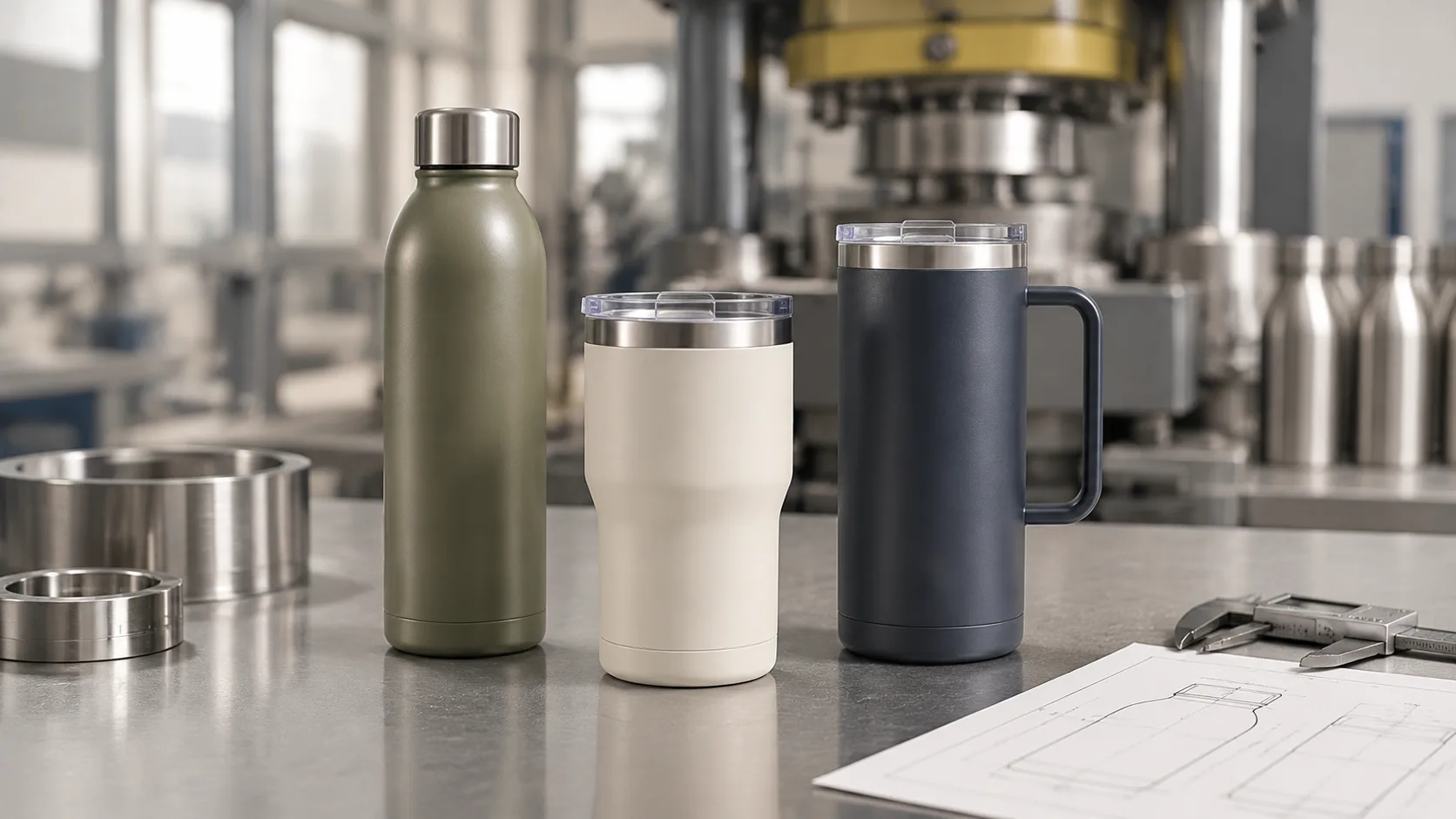
Bottle Shape Determines the Forming Process
Stainless steel bottle bodies are commonly produced through processes such as deep drawing and hydroforming. The appropriate method depends on the material, body geometry and product construction. Deep drawing uses a press and forming dies to shape flat stainless steel into a three-dimensional component. It is widely used for cylindrical bodies and certain tapered profiles. Hydroforming uses fluid pressure to shape metal tubing against a die, making it suitable for bodies with changing diameters, rounded contours and more sculpted profiles.
Each method imposes different constraints on the geometry that can be formed. A relatively straight body may suit conventional drawing operations, while a more complex silhouette may require additional forming stages or a different production route. These distinctions affect the range of shapes available to a product designer. Reviewing forming feasibility early helps establish whether the intended profile can be achieved without compromising dimensional accuracy or the consistency of the finished bottle.
How Body Proportions Affect Dimensional Consistency
Bottle height, diameter and changes in profile determine how far the stainless steel must stretch and redistribute during forming. The more demanding the deformation, the greater the need to control material flow and wall-thickness distribution. Tall, narrow bodies and pronounced changes in diameter can require more careful process development than relatively uniform cylindrical forms. Depending on the geometry and material thickness, certain designs may need multiple forming stages or adjustments to forming conditions. Insufficient control can result in local thinning, wrinkles or dimensional variation. These defects affect more than the appearance of the bottle. They can also influence the fit of assembled components and make it harder to maintain consistent product specifications across a production run.
For brands, dimensional consistency is particularly important when a bottle combines a formed body with a separate lid, base component or other fitted parts. The geometry established during forming must remain within the tolerances required by subsequent assembly and finishing operations.
Curves and Shoulder Design Affect Forming and Lid Fit
Curves, tapered sections and sculpted shoulders give a bottle its distinctive profile, but their geometry also affects how the metal responds during forming. Tight radii and abrupt transitions can concentrate stress, increasing the risk of cracking, wrinkling or local wall thinning. More gradual transitions generally allow the material to flow more predictably, although the appropriate radii depend on the material, thickness and selected process. The shoulder and neck are particularly important because they connect the main body to the opening. If the transition is difficult to form, the mouth may develop dimensional deviations or lose roundness. Even small variations can complicate lid assembly, affect thread engagement or alter sealing-ring compression.
For a brand, these issues can translate into inconsistent opening and closing performance or an increased risk of leakage. A well-resolved shoulder profile therefore needs to satisfy both the intended appearance and the dimensional requirements of the closure system. Surface finishing introduces another consideration. Complex curves and recessed areas can be more difficult to polish or coat evenly. Where a product requires a uniform metallic finish or color coating, the shape should be evaluated for its effect on both forming and surface quality.
Base Geometry Affects Stability and Construction
The base contributes to the bottle’s rigidity and ability to stand securely. Its shape also determines how the lower section is formed and how the base connects to the rest of the structure. Depending on the design, the bottom may be formed as part of a component or produced separately and welded to the body. The chosen construction influences the joining process and the dimensional control required around the base.
A poorly resolved transition between the sidewall and base can complicate forming or leave the finished structure more susceptible to deformation. A suitable supporting ring or reinforcing contour can improve rigidity, provided it is compatible with the product’s geometry and manufacturing process. Vacuum-insulated bottles require particular attention to the integrity of their sealed construction. Welding quality and vacuum processing are essential to maintaining the vacuum space between the inner and outer walls. Defects in critical joints or sealed areas can compromise insulation performance. Base design should therefore be considered in relation to the complete bottle structure, including its stability, joining requirements and vacuum integrity.
Bottle Geometry and Vacuum Insulation
Bottle shape alone does not determine thermal retention. Performance depends on the vacuum insulation system, the construction of the inner and outer walls, the lid and the quality of the manufacturing process. Geometry plays an important role in producing that construction. Changes in the body profile can affect forming conditions and wall-thickness distribution. The design must also accommodate the structure of the inner and outer vessels and the processes required to establish and maintain the vacuum space.
This matters when developing bottles with unusual proportions or sculpted contours. A visually distinctive design should be assessed against the required thermal performance rather than assumed to perform equally well simply because it uses the same stainless steel material. Prototype evaluation provides a way to verify the complete design. Dimensional checks, lid-fit assessments, leakage tests and thermal retention testing can establish whether the finished construction meets the agreed product specifications.
Translating Design Intent into a Manufacturable Product
A successful bottle design must retain its intended appearance while meeting the requirements of forming, assembly, finishing and performance testing. These considerations are best reviewed together, before the geometry is finalized. The main areas of assessment include the feasibility of the forming process, wall-thickness distribution, dimensional accuracy around the mouth and shoulder, base construction, surface finish and compatibility with the selected lid. Prototype results should then be used to verify that the design meets the required specifications, rather than relying on appearance alone.
At Ansune, stainless steel forming, hydroforming, metalworking, welding and vacuum processing contribute to the production of insulated drinkware. Integrating these manufacturing considerations into product development helps brands turn design concepts into bottles that maintain their intended appearance, fit and performance in mass production.