


Scratches and worn finishes are common complaints in stainless steel drinkware. A bottle may leave the factory with a flawless surface, yet develop visible marks from keys, bags, repeated handling or washing. For brands, these defects can affect perceived quality, customer satisfaction and return rates, particularly in products positioned at the premium end of the market.
Improving scratch and abrasion resistance starts with understanding where the protection comes from. Stainless steel provides structural strength and corrosion resistance, but its relatively low surface hardness makes it vulnerable to scratching. Surface treatments and coatings offer more effective ways to improve wear performance, although each comes with different limitations in appearance, durability, cost and production capacity. The right solution depends on how the drinkware will be used, the finish a brand wants to achieve and the performance it needs to demonstrate through testing.
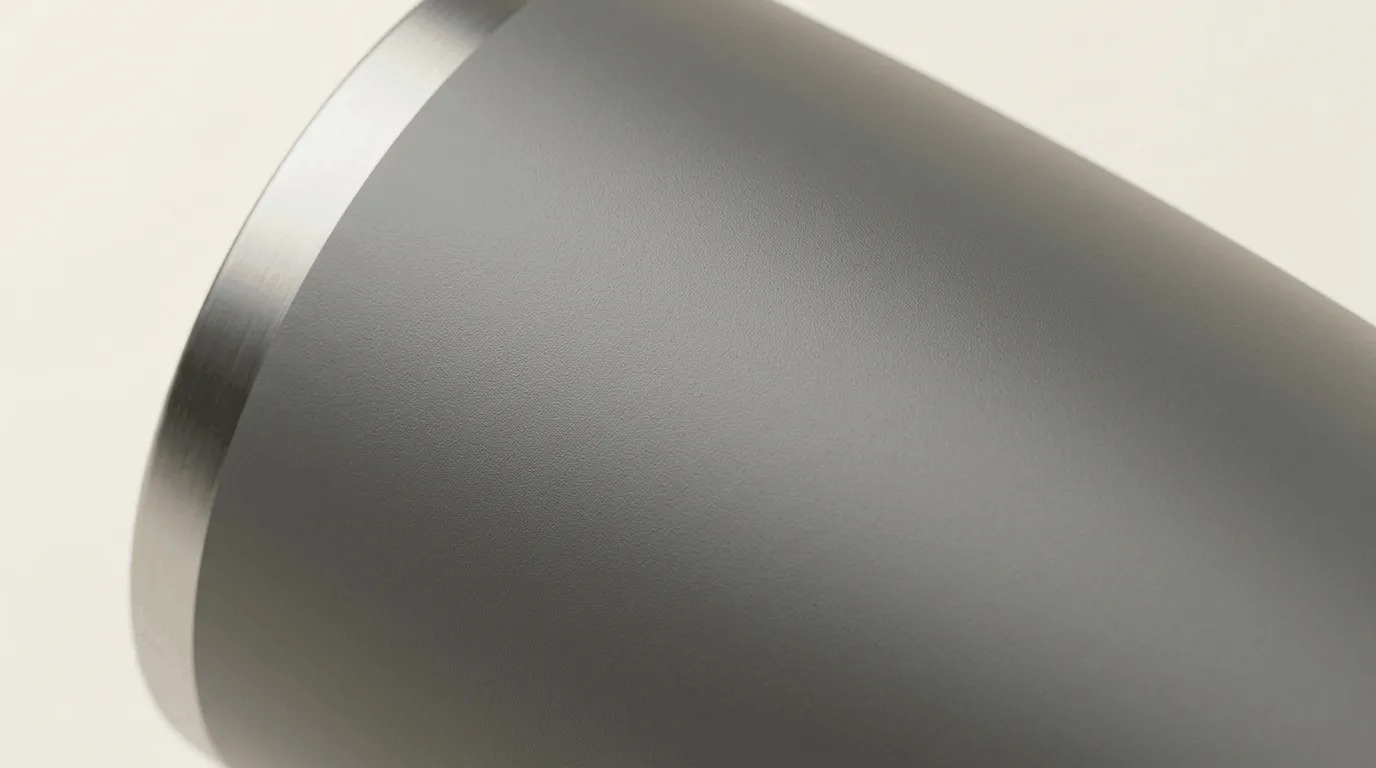
1. Start with the Right Stainless Steel Grade
304 and 316L are common material choices for stainless steel drinkware. Both belong to the austenitic stainless steel family and offer good corrosion resistance, but neither is particularly hard in its conventional annealed condition. Switching from 304 to 316L does not meaningfully solve scratching. The molybdenum in 316L improves resistance to chloride-induced pitting corrosion, making it a useful option for applications exposed to salt, certain beverages or more aggressive environments. Its hardness, however, remains broadly comparable to that of 304.
Cold working can increase the hardness of austenitic stainless steel, but the improvement is limited by the degree of deformation and the material condition. It can also increase springback and make forming more difficult. For drawn bottle bodies, these trade-offs need to be considered alongside dimensional accuracy and production consistency. Austenitic stainless steel cannot be hardened by conventional quenching in the same way as carbon steel. Material selection should therefore be based primarily on corrosion requirements, forming characteristics and cost, rather than an expectation that a higher stainless steel grade will prevent scratches. For product developers, the distinction is straightforward: the steel grade establishes the corrosion-resistance baseline; the surface treatment largely determines how well the finished exterior withstands visible wear.
2. Understand What Each Surface Treatment Actually Does
Not every finish marketed as durable increases surface hardness. Some make scratches less visible, while others create a harder surface or add a protective coating. These are different performance outcomes and should not be evaluated interchangeably.
- Brushed and Sandblasted Finishes
Brushing creates directional surface lines that help blend minor scratches into the existing texture. When a new mark follows the same direction as the original grain, it may be less noticeable than it would be on a smooth, glossy surface. Sandblasting creates a matte texture that can also reduce the visibility of minor surface marks. However, the resulting microscopic surface irregularities may retain dirt and contaminants if the finish is poorly controlled or difficult to clean.
Neither process inherently provides a substantial increase in scratch resistance. Their main advantage is visual: they can make everyday wear less conspicuous. For brands targeting frequent-use drinkware, this distinction matters. A finish that conceals light scratches can maintain its appearance better in everyday conditions without necessarily offering greater resistance to the forces that cause those scratches.
- Electropolishing and Passivation
Electropolishing removes a controlled amount of material from the stainless steel surface, smoothing microscopic peaks and improving surface cleanliness. It can enhance corrosion resistance by reducing surface irregularities and removing contamination, but it does not substantially increase the hardness of the underlying steel. Passivation promotes the formation of a protective chromium-rich oxide film. This thin film is important for corrosion resistance, but it provides little meaningful improvement in mechanical scratch resistance. Both processes serve useful purposes in stainless steel manufacturing. Neither should be treated as a substitute for a hard-wearing exterior finish.
- Low-Temperature Nitriding
Low-temperature nitriding introduces nitrogen into the surface of stainless steel, creating a hardened diffusion layer without relying on a conventional applied coating. Properly controlled processes can significantly increase surface hardness while retaining a metallic appearance. The main considerations are processing cost, treatment consistency, dimensional requirements and potential changes in surface color. Process conditions must also preserve the corrosion resistance expected from stainless steel. Nitriding can be relevant to specialized, higher-value products, but it is less common than conventional finishing and coating methods in high-volume drinkware production.
3. Compare the Main Coating Options
For most commercial drinkware, the practical choice is between PVD, ceramic-filled coatings and conventional powder coating or liquid paint. Their performance depends on the specific formulation, pretreatment and application process, not just the name of the technology.
| Surface Treatment | Main Advantage | Main Limitation | Typical Application |
| PVD Coating | High surface hardness and strong wear potential; offers premium metallic finishes. | Higher cost; impact damage and coating defects remain possible. | Premium metallic finishes |
| Ceramic-filled Coating | Can combine a refined matte feel with improved wear performance. | Results depend heavily on formulation, curing, and adhesion. | Mid- to high-end drinkware. |
| Powder Coating | Broad color selection and scalable production. | Conventional formulations may scratch through to the substrate. | High-volume colored drinkware. |
| Liquid Paint | Flexible appearance and finish options at a relatively low cost. | Durability varies; scratches may expose the steel underneath. | Cost-sensitive products. |
- PVD Coating: For Hard, Metallic Finishes
Physical vapor deposition (PVD) forms a thin, hard coating on the prepared surface. Depending on the coating system, materials such as titanium nitride, titanium carbonitride or chromium nitride can provide strong resistance to scratching and abrasion. PVD is attractive for premium drinkware because it can produce metallic colors and a refined finish without the appearance of conventional paint. Its thin film also avoids some of the dimensional and thermal-expansion considerations associated with thicker coatings.
However, PVD is not damage-proof. A sufficiently hard abrasive can scratch the surface, while a strong impact may cause localized cracking or coating damage. Coverage around edges, recesses and complex geometries also requires careful process control. Production capacity is another consideration. PVD equipment has finite batch capacity, and large orders or complex color requirements may affect lead times.
Best fit: premium products where metallic appearance, surface hardness and perceived finish quality justify the additional cost.
- Ceramic-Filled Coatings: Balancing Feel and Durability
Ceramic coatings used on consumer products vary considerably in composition. Many liquid-applied ceramic coatings contain ceramic particles dispersed in an organic binder; they are not necessarily pure ceramic layers. A well-formulated coating can offer a smooth matte feel, good surface hardness and improved abrasion resistance compared with conventional paint. Actual results depend on particle distribution, binder chemistry, film formation, curing conditions and adhesion to the substrate. The term ceramic alone does not guarantee superior performance. Brands should evaluate the specific coating system and request test results for the intended use conditions.
Best fit: products that require a distinctive matte appearance and improved wear performance without moving to the cost and production requirements of PVD.
- Powder Coating: For Scalable Color and Production
Powder coating is widely used for colored stainless steel drinkware because it supports a broad range of colors, textures and finishes and is compatible with large-scale manufacturing. Its durability varies with resin chemistry, formulation, film thickness, pretreatment and curing. Standard formulations may withstand ordinary handling but still be marked by hard objects such as keys or exposed to substrate damage when a scratch penetrates the coating. Higher-performance formulations can improve hardness and abrasion resistance, but these properties need to be verified on the finished product. Increasing film thickness alone is not a reliable way to improve durability. Powder coating also requires attention to edge coverage, coating uniformity and the compatibility of the curing process with the product construction.
Best fit: high-volume drinkware where color flexibility, cost control and production efficiency are priorities.
- Liquid Paint: When Appearance and Cost Take Priority
Liquid paint provides flexibility in color, gloss, texture and application. It can be suitable for products with moderate durability requirements, but its scratch and abrasion resistance varies substantially by coating chemistry and application quality. For products exposed to frequent contact, rough handling or repeated washing, conventional paint may show wear earlier than a well-engineered powder coating or PVD system.
Brands should specify the required performance rather than assuming that all paints offer similar durability. One important distinction across all coating options is that hardness, abrasion resistance and adhesion measure different properties. A hard coating can still fail if it bonds poorly to the substrate, and a well-adhered coating can still develop visible scratches under sufficient contact pressure.
4. Match the Finish to the Intended Use
The best coating depends on the conditions the product will encounter.
-
Office and commuting: Conventional powder coating may provide a suitable balance of appearance, cost and durability. Brushed finishes can make minor scratches less noticeable.
-
Outdoor and active use: Grit, sand and impacts increase wear risk. Evaluate PVD or high-performance coatings, while recognizing that no finish is completely scratch-proof.
-
Dishwasher use: Detergents, heat and repeated washing can cause discoloration, cracking or adhesion loss. Test the complete finished product under the intended washing conditions.
-
Hot and cold temperature cycles: Differences in thermal expansion can stress the coating and substrate. Thermal cycling helps identify risks of cracking or delamination.
Substrate selection remains important when a coating is damaged. In chloride-rich environments, 316L offers better pitting-corrosion resistance than 304, but neither grade eliminates corrosion risk under all conditions.
5. Define Performance Tests Before Approval
A finish should be approved against measurable criteria, not a general claim of being scratch-resistant. Scratch testing evaluates resistance to controlled surface damage, while pencil hardness provides a specific measure of coating hardness rather than a direct prediction of resistance to keys or grit. Abrasion testing, such as the Taber method where applicable, assesses wear under defined loads and cycle counts. Cross-cut testing can help assess coating adhesion, although it does not establish scratch resistance on its own.
Corrosion testing should reflect the intended environment, particularly where coating damage may expose the substrate. For dishwasher-safe products, repeated washing should be followed by checks for discoloration, blistering, cracking and adhesion loss. Thermal cycling can reveal additional coating failures. Coatings or components that may contact beverages must also meet applicable food-contact requirements, including relevant migration testing. When comparing suppliers, use consistent test methods and acceptance criteria. A high pencil-hardness rating alone does not establish superior overall durability.
6. Balance Durability with Cost and Production
The most expensive finish is not always the best choice. Coating costs, production capacity, lead times, color consistency and rework rates all affect product economics. For value-oriented products, brushing combined with conventional powder coating or paint may be sufficient when appearance and wear requirements are moderate. Mid-range products may benefit from higher-performance powder coatings or ceramic-filled systems. Premium products can justify PVD when metallic appearance and surface hardness are priorities, provided impact resistance and production consistency are validated. These are starting points rather than fixed rankings. Actual performance depends on the complete coating system and manufacturing process.
Key Takeaway
Improving scratch and abrasion resistance requires the right combination of stainless steel grade, surface treatment and application-specific testing. 304 and 316L primarily address corrosion resistance. Brushing and sandblasting help conceal visible wear, while PVD and suitable high-performance coatings can improve resistance to surface damage.
For brands developing stainless steel drinkware, the priority is to define the expected use conditions, select a finish that fits the product's market position, and verify its performance before mass production. Durability should be a tested product specification, not an assumption based on material grade or coating name.